Repurposing
Repurposed drugs: the value was never in the molecule
No composition-of-matter patent, and any physician can prescribe the generic off-label. Both objections are true. Neither decides what the asset is worth.
Every founder with a repurposed drug hears the same two objections in the first investor meeting. There is no composition-of-matter patent, so the asset is worth a fraction of a new chemical entity. And once the data are published, any physician can prescribe the generic off-label, so the company may end up funding a trial for the benefit of the generic industry.
Both objections are true. Both are also beside the point. A drug is worth what its cash flows are worth: how long they last, how well they are defended, and how likely they are to arrive at all (the same logic set out in How to value a life sciences patent before you start a company). A molecule patent is one way to defend those cash flows. It is not the only way. The record of the last thirty years shows repurposed products built into multi-billion-dollar franchises without it, and products with airtight exclusivity that collapsed within a few years. The patent was not the difference. The architecture of the product was.
The arithmetic that investors do not run
Start with cost and time. A 2016 feature in Nature put a de novo drug at 13 to 15 years and $2 to 3 billion, against estimates of roughly $300 million and 6.5 years for a repositioned one (Nosengo, "Can you teach old drugs new tricks?", Nature, 2016). Those are comparative estimates, not rules, and the same piece adds the part founders forget: repositioned drugs still face phase II and phase III, which eliminate 68% and 40% of the compounds that reach them. Repurposing removes discovery risk and most of the toxicology. It does not remove clinical risk.
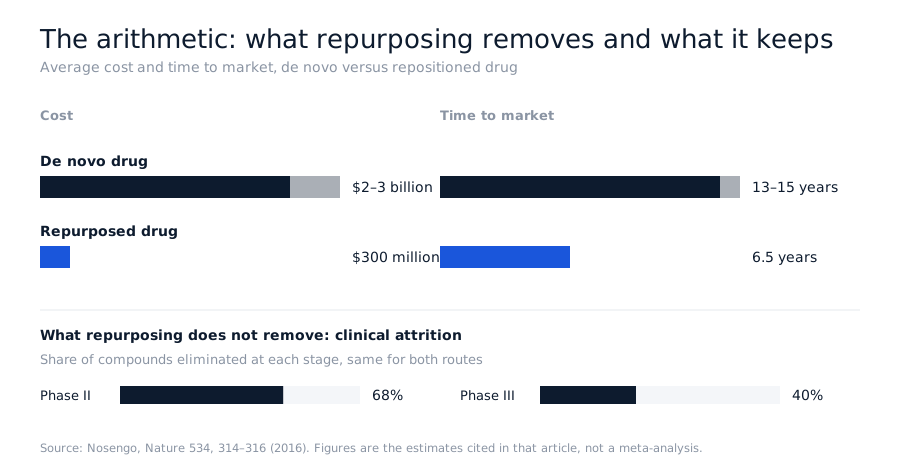
That changes the return calculation more than founders usually articulate. An investor does not buy peak sales; she buys risk-adjusted return per euro invested. A programme that costs a tenth of a de novo asset and reaches market in half the time can live with a much lower sales ceiling and still return more capital. The natural acquirer is often not a top-ten pharma company, whose commercial machine needs blockbusters, but the specialty tier whose business is precisely buying protected, mid-sized, de-risked products. Otsuka, Jazz, Ipsen, Supernus and Takeda's specialty units have all done it. Pricing the asset for the wrong buyer is the first way founders lose the meeting; what that buyer looks for is in Five conditions a pharma company needs before it buys.
What replaces the patent
What stands in for the molecule patent is regulatory exclusivity, and it is stronger than most scientists assume, as long as you read the small print.
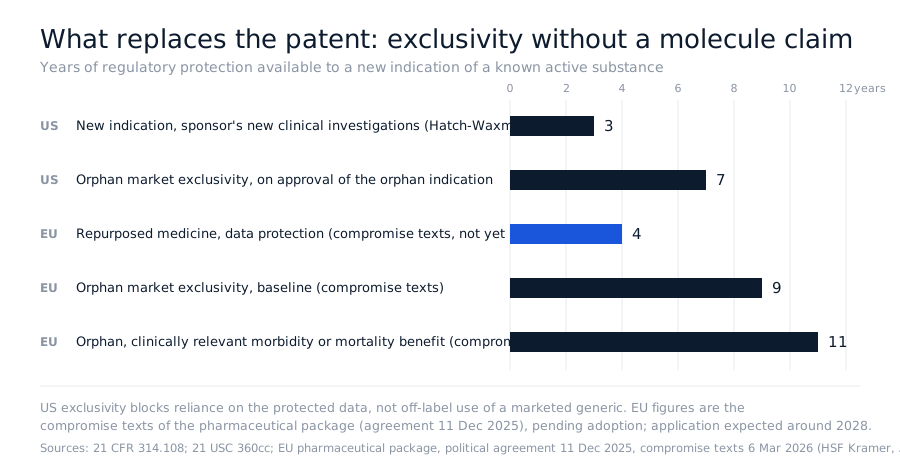
In the United States, a new indication backed by new clinical trials that the sponsor ran itself can earn three years during which no generic may lean on those data for that use. A rare-disease indication, once approved, earns seven years of orphan exclusivity during which the FDA will not approve the same drug for the same disease. Neither is a wall: a generic already on the shelf for an older use stays on the shelf, and a physician can still prescribe it. What the exclusivity protects is the approval, not the prescription pad.
Europe is rewriting its rules, and the new regime is not yet law. Parliament and Council reached a provisional agreement in December 2025; adoption and a transition period follow, with application expected around 2028. If the compromise texts hold, new products keep eight years of data protection and get a shorter baseline market protection with conditional extensions. The provision that matters here is a new one: four years of data protection, granted once, for an old medicine that earns a genuinely new indication with significant clinical benefit, provided the product is a generic that never had data protection or has been on the market for at least 25 years. Orphan exclusivity would move from ten years to nine, with extensions to eleven for products that clearly reduce morbidity or mortality (HSF Kramer; Crowell & Moring, 2026).
For a rare tumour, then, orphan exclusivity is often the main regulatory protection, and it does not depend on a single patent surviving. It still has to be earned at approval and defended against a rival claiming clinical superiority. For a common disease, method-of-use and formulation patents remain necessary and can be very valuable, but they are easier to design around, challenge and sidestep with a carved-out label than a strong molecule claim. How well they hold depends on the claims and the facts, not on the category.
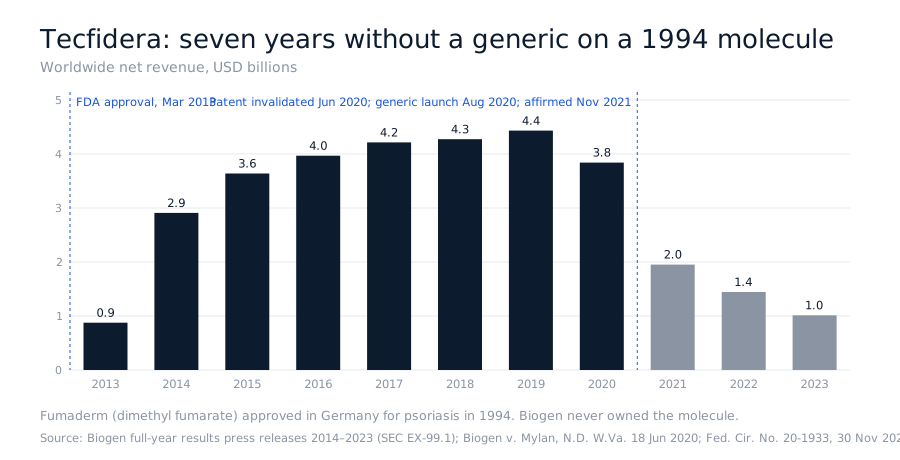
Tecfidera shows both the upside and the limit. Dimethyl fumarate had been sold in Germany as Fumaderm for psoriasis since 1994. Biogen took it through phase III in multiple sclerosis and won FDA approval in March 2013. Worldwide sales reached $4.43 billion in 2019 (Biogen, full-year results). In June 2020 a US district court invalidated the key method-of-treatment patent; Mylan launched its generic that August, and sales fell to $1.95 billion in 2021 and $1.44 billion in 2022. The patent did not hold. It did not need to hold forever. Seven years without a generic, on a molecule Biogen never invented, is a return most first-in-class programmes never see.
The off-label problem is a product-design problem
The second objection deserves a sharper formulation than founders usually give it. The risk is not that a physician may prescribe the generic off-label. The risk is that the market can get to the same result without you: a generic swapped in at the pharmacy, an old product prescribed for the new use, or a compounded version where the rules allow it. If it can, your only asset is the clinical evidence, and evidence, once published, belongs to everyone. If it cannot, you have a product.
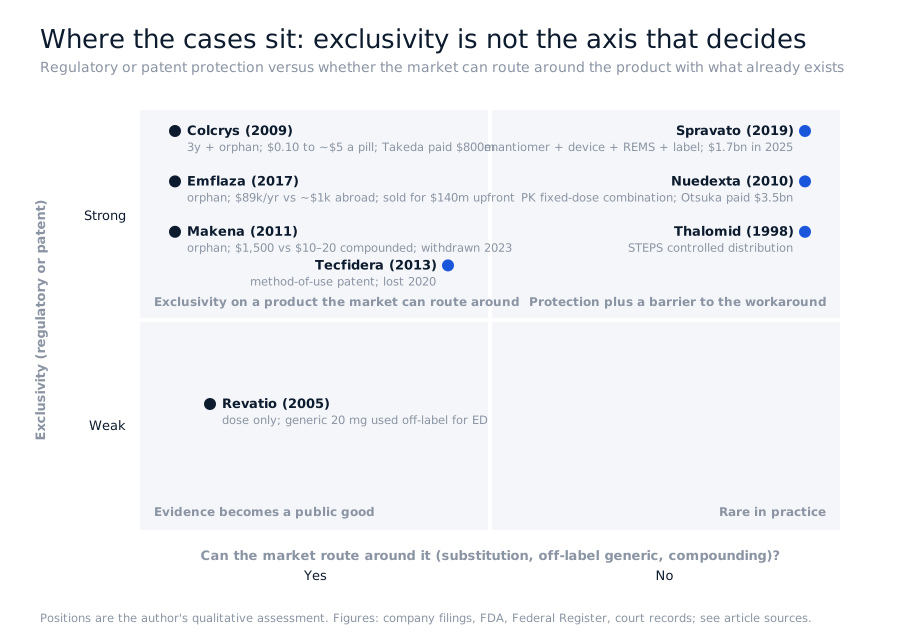
Dose alone does not stop it. Pfizer launched sildenafil 20 mg as Revatio for pulmonary hypertension in 2005, a fifth of the Viagra strength. Once the 20 mg generic arrived, physicians began prescribing three to five tablets for erectile dysfunction as a cost-saving workaround, a practice Consumer Reports documented with named endocrinologists. The label distinction survived on paper. In the pharmacy it did not.
The products that held made the workaround impractical, unsafe or unfunded.
Nuedexta, from Avanir, is a fixed-dose combination of dextromethorphan and quinidine for pseudobulbar affect, approved in October 2010. Both components are decades-old generics. The quinidine is there in a small dose to slow the breakdown of dextromethorphan, so the fixed ratio, dose and titration matter; two separate prescriptions do not give the same exposure or the same safety margin, and no label supports them. Otsuka paid $3.5 billion for Avanir in December 2014, when Nuedexta was selling $26.5 million a quarter (Avanir, SEC filing): roughly thirty times the annualised run-rate, for two commodity molecules put together properly.
Spravato, Johnson & Johnson's esketamine, is one half of a 1970 anaesthetic, delivered through a proprietary nasal device and taken under supervision in a certified clinic, as the FDA's risk-management programme requires. Ketamine clinics exist and prescribe the old racemic drug off-label for a fraction of the price. Spravato nonetheless sold $1.08 billion in 2024 and $1.70 billion in 2025 (J&J, full-year results). The supervision requirement is not an exclusivity right and it does not ban the alternative. Combined with the enantiomer, the device, the label and a reimbursement path built around observed dosing, it makes the product hard to route around. It is not a burden the company tolerates. It is part of the moat.
The oldest example is among the clearest. When Celgene won approval for thalidomide in July 1998, it came with the STEPS programme: registered physicians, mandatory pregnancy tests, one-month prescriptions, patient registries. Controlled distribution was the condition of approval, and it became the commercial architecture on which Celgene built everything that followed.
The common thread is that formulation, combination, device and controlled distribution each turn a piece of public evidence into a product that has to be bought from one source. That, not the patent, is what a buyer pays for.
Like what you're reading?
Subscribe for more strategic notes on biotech and venture design.
When exclusivity is all you have
The counter-examples are just as instructive, and the pattern repeats: exclusivity on a product the market could route around, priced on the exclusivity alone.
Colchicine had been sold in the United States for a century without formal approval. URL Pharma ran the trials, won approval for Colcrys in 2009 and received three years of exclusivity for gout plus orphan exclusivity for familial Mediterranean fever. The price went from about ten cents a pill to about five dollars (Slate, 2011). Takeda bought the company for $800 million in 2012. The money was real; so was the political damage, and the pathway has been radioactive ever since.
Makena, for recurrent preterm birth, was approved in 2011 with orphan exclusivity and priced at about $1,500 an injection against $10 to $20 for the compounded version obstetricians had used for years (NBC News, 2011). Compounding pharmacies kept supplying it, the FDA declined to stop them, and the confirmatory trial then failed to show benefit. Approval was withdrawn in 2023. Two lessons, not one: exclusivity does not stop substitution when the product is trivially copiable, and an approval built on a surrogate endpoint is a liability the buyer will price.
Emflaza, deflazacort for Duchenne muscular dystrophy, was approved in February 2017 and listed by Marathon at $89,000 a year for a steroid families had been importing for around $1,000 (CNBC, 2017). The reaction was immediate. Within weeks Marathon sold it to PTC Therapeutics for $140 million upfront, a fraction of what seven years of orphan exclusivity should have been worth on paper.
The difference between these three and Nuedexta or Spravato is not the regulatory instrument. Colcrys and Makena had exclusivity Nuedexta never had. The difference is that nothing about the product stopped the market from going around it.
Skinny labels and the courts
Where a method-of-use patent is the only protection, the practical question is whether a generic can enter with a label that leaves out the patented use and then be prescribed for it anyway. In the United States that question has moved in the patent holder's favour, then partly back. In 2021 the Federal Circuit let GSK collect damages from Teva over carvedilol, because Teva's marketing had described its generic as equivalent for all uses despite the carve-out. In 2024 it let Amarin pursue Hikma on similar grounds. In June 2026 the Supreme Court, in Hikma v. Amarin, raised the bar: a patent holder now has to show that the generic actively encouraged the patented use, and a carved-out label that must by law mirror the brand's is not evidence of that. Method-of-use patents remain enforceable, and promotion aimed at the patented use remains actionable. A generic that keeps its marketing disciplined can enter; one that does not can be sued. That is a deterrent, not a wall.
Europe offers less. Second-medical-use patents exist and are enforceable in principle, but the UK Supreme Court's 2018 pregabalin decision, which struck down the relevant claims and left unresolved what a generic must do to stay clear of them, shows how thin that protection is in practice. A European strategy that rests on a method-of-use patent alone rests on the goodwill of national prescribing systems.
A note on Italy
Founders from Italian institutions should know that their home market is among the least hospitable to a repurposed product the market can route around. Two laws matter and they are often confused. Law 94/1998 lets a physician prescribe off-label on his own responsibility, with the patient's consent and normally at the patient's or the hospital's expense; it pays for nothing. Law 648/1996 is the route that pays, and it is neither general nor automatic: AIFA evaluates a specific off-label use and, if it qualifies, puts it on a list funded by the national health service, historically where no approved alternative exists. Since 2014 the route is wider. A reform passed for the bevacizumab-versus-ranibizumab dispute in eye disease lets AIFA list an off-label use even when an approved alternative exists, if the use is established in the literature and cheaper for the system (Law 79/2014). Bevacizumab has been on that list for macular degeneration since 2014, with further eye indications added since. For a repurposed generic with published evidence, the consequence is direct: an approved, branded version does not automatically push the reimbursed generic off the list. In Italy, published evidence can be institutionalised against you, with the payer's signature on it.
What a buyer actually looks at
Pull the cases together and the acquirer's checklist is short. How many years of protected cash flow, and from which instrument: orphan exclusivity, data protection, a method-of-use patent that will be challenged, a formulation patent that is harder to get around? Can the market reach the same result with what already exists, and if so what stops it: a pharmacokinetic reason, a device, a supervised-dosing programme, a controlled supply chain? Is reimbursement tied to the approved label, so the off-label route is legal but unfunded? And is there something proprietary beyond the molecule?
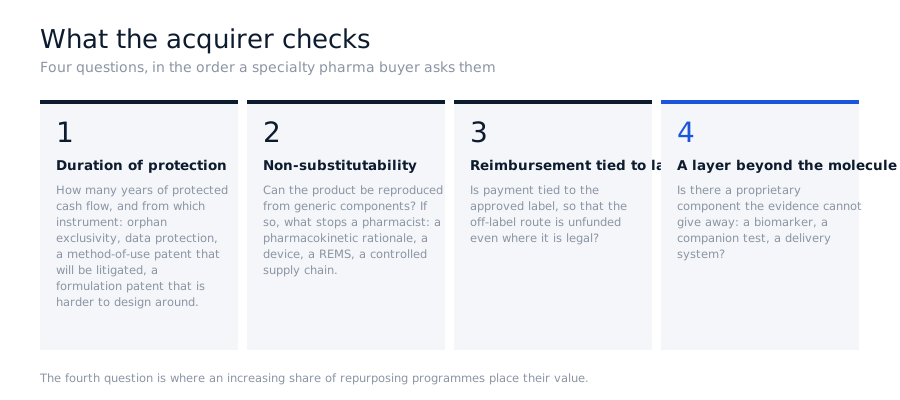
That last question is where a growing number of repurposing programmes put their value. A biomarker that picks out the responding patients, if it can be protected as a diagnostic and reimbursed as a companion test, turns a commodity drug into a guided therapy: the generic can be prescribed but not targeted, and the acquirer values the test with the drug. None of that is automatic. Whether the biomarker is patentable depends on the jurisdiction and the claims; a companion diagnostic under IVDR is a regulatory category, not a reimbursement decision, and its funding follows its own slow path. Diagnostics are harder economics than drugs. But a programme that owns the selection criterion owns the part of the product that evidence alone cannot give away.
Founders who reach the investor meeting with these answers are not defending a weak asset. They are describing a different one: shorter path, lower cost, a smaller but more probable outcome. The objection about composition of matter does not go away. It stops being the question that decides the meeting. What decides it is the same architecture that decides every raise: the exit first, the evidence package second, the deck last.
Sources and notes33 references
- ›Nosengo N., "Can you teach old drugs new tricks?", Nature 534, 314-316 (2016), doi:10.1038/534314a.
- ›Pushpakom S. et al., "Drug repurposing: progress, challenges and recommendations", Nature Reviews Drug Discovery 18, 41-58 (2019).
- ›Breckenridge A., Jacob R., "Overcoming the legal and regulatory barriers to drug repurposing", Nature Reviews Drug Discovery 18, 1-2 (2019).
- ›HSF Kramer, "The EU Pharma Package is finally here" (April 2026).
- ›Crowell & Moring, "The new EU Pharma Package: regulatory data protection, a comparison of Commission, Parliament and Council positions".
- ›Covington, Inside EU Life Sciences, "EU Pharma Legislation Review Series: Regulatory Data Protection" (Article 84 of the proposed Directive).
- ›Osborne Clarke, "EU overhauls pharmaceutical law" (2026).
- ›European Parliament, Legislative Train, revision of the pharmaceutical legislation.
- ›Biogen, full-year 2019 results.
- ›Biogen, full-year 2022 results.
- ›Federal Circuit, Biogen v. Mylan, No. 20-1933 (30 November 2021).
- ›Viatris press release, 1 December 2021 (Federal Circuit affirmance).
- ›Mylan press release, 18 June 2020.
- ›FDA approval letter, Nuedexta NDA 021879 (29 October 2010).
- ›Otsuka, acquisition of Avanir, 2 December 2014.
- ›Avanir, Q3 FY2014 results (SEC 8-K).
- ›Johnson & Johnson, Q4 and full-year 2025 results.
- ›SPRAVATO REMS.
- ›Slate, "The colchicine price increase" (March 2011).
- ›Takeda, acquisition of URL Pharma (April 2012).
- ›NBC News, Makena price (2011).
- ›Federal Register, final decision on withdrawal of Makena (15 May 2023).
- ›CNBC, Emflaza pricing (February 2017).
- ›PTC Therapeutics, Emflaza acquisition (SEC exhibit).
- ›Cooley, GSK v. Teva rehearing opinion (August 2021).
- ›Patently-O, Amarin v. Hikma (June 2024).
- ›WilmerHale, Hikma v. Amarin, Supreme Court (June 2026).
- ›Consumer Reports, "How to get generic Viagra".
- ›FDA, thalidomide STEPS/REMS documentation.
- ›AIFA, Legge 648/96.
- ›AIFA, determina n. 37250/2021, bevacizumab, Legge 648/96.
- ›Legge 79/2014, art. 3 (modifica all'art. 1, comma 4-bis, DL 536/1996).
- ›Warner-Lambert v Generics (UK) [2018] UKSC 56.
Frequently asked questions
Continue with
Your asset has evidence but no molecule patent. Let's map which instruments protect it and which buyer pays for it.
Book a 30-minute conversation