The asset on the other side of the desk
European biotech is no longer judged on its own merits. It is judged next to a China-origin asset that arrives with the clinical data already generated, and the H1 2026 numbers show how far that has gone.
Capital returned to biopharma in 2026. It stopped at a later stage, and it started comparing your asset to something you have never seen.
The science earns the meeting. The comparison decides the deal.
$16.3B
Biopharma venture funding, H1 2026 across 235 rounds
71%
Of that capital went to Series B and later rounds
68%
Of large-cap pharma upfront licensing dollars went to China-origin assets
I have argued before that VCs aren't your buyer, pharma is. The data has moved since, and not in the direction I expected. The financing environment improved. The position of a European early-stage asset inside it got worse. Those two things are not in tension. They are the same fact seen from two ends.
The money came back
Biopharma venture funding reached $16.3 billion across 235 rounds in the first half of 2026, with $9.2 billion of that in the second quarter alone, according to J.P. Morgan's Q2 2026 Biopharma Licensing and Venture Report, produced with DealForma and reflecting data through 30 June 2026. The pace implies roughly $33 billion for the full year. Public markets moved with it. Biopharma IPOs raised $5 billion across 13 offerings in the first half, already more than any full year since 2022, and the XBI rose 30.2% over the period against 9.3% for the S&P 500.
By any reasonable reading, this is a recovery.
The distribution is where the recovery stops being good news. Series B and later rounds absorbed 71% of deployed capital in the first half, against 62% in 2025. Seed and Series A companies raised $4.8 billion across 114 deals. Later rounds took $11.5 billion across 121. The deal counts are nearly identical. The money is more than double.
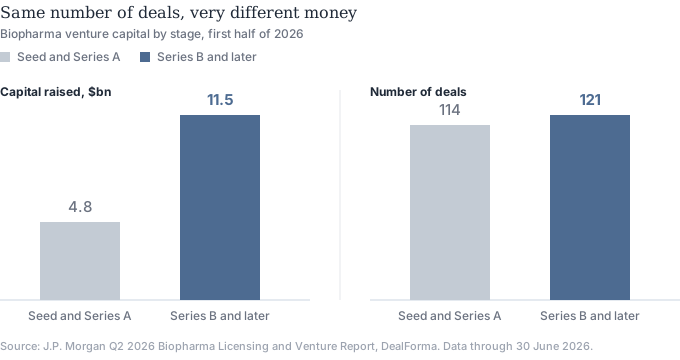
Median round sizes tell the same story from another angle. A platform or discovery company raised a median of $22 million in the first half of 2026, down from $37 million in 2025. Preclinical companies raised $29 million. Phase II companies raised $63 million. The market did not run out of money. It raised the price of admission.
Why 68 per cent is the number that matters
The number I keep returning to sits further down the report, and almost nobody in Europe is reading it as a competitive fact.
Large-cap pharma completed 10 licensing deals with China-origin assets carrying at least $50 million upfront in the first half of 2026, totalling $4.4 billion in upfront cash and equity. Those deals were 42% of all global big pharma licensing transactions above that upfront threshold, and 68% of the upfront dollars paid in that group. In 2021, that share of dollars was 4%.
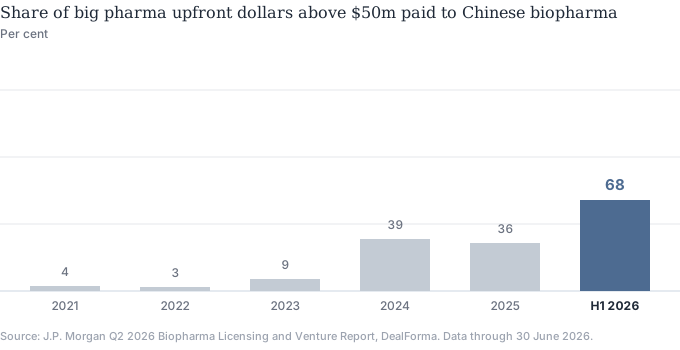
The top five licensing deals of the period all involved a Chinese out-licensor. The two largest were AstraZeneca with CSPC Pharma at $18.5 billion in announced value, and Bristol Myers Squibb with Jiangsu Hengrui Pharma at $15.2 billion.
This is not a shift in sourcing preference. It is a shift in where pharma looks first when it needs to replace revenue. And it has a mirror image in the European numbers: European biopharma companies raised $2.3 billion in the first half of 2026, down from $3.5 billion in the same period of 2025, while the global market grew. Across 2025 and the first half of 2026 combined, Europe raised $8.2 billion across 184 rounds, with the United Kingdom and Switzerland taking 54% of the capital.
European science did not get worse in eighteen months. Something else moved.
What sits on the desk
| European early-stage asset | China-origin asset | |
|---|---|---|
| Stage of evidence | Preclinical or early clinical | Clinical data already generated |
| IP posture | Often academic-origin, needs restructuring | Already structured for out-licensing |
| Cost to buyer | Fund the trials to reach parity | Price already reflects lower development cost |
| Timeline to equivalence | Multiple years of additional work | Ready to advance now |
What a business development team actually does
Here is the mechanic that founders consistently miss, and it is not about narrative quality.
A business development team never evaluates your asset in isolation. It evaluates your asset against the other things it could do with the same budget, in the same therapeutic area, this year. That comparison set used to be mostly domestic and mostly early. It now routinely includes an asset that arrives with clinical data already generated, an IP position already structured for out-licensing, and a cost of development that makes the price look reasonable.
Set against that, a European preclinical asset is not being judged on whether the biology is good. It is being judged on what it would cost to bring it to the same place, and how long that would take. The question in the room is not "is this interesting". It is "why this, rather than the one already on the desk".
That question then has to survive a committee, which is where licensing deals actually get done. The BD contact becomes your internal champion, and what they carry into that room is your case, not your enthusiasm. A champion who cannot answer the comparison question loses quietly. Most deals do not end in rejection. They end in silence, and the vocabulary of that silence is worth learning to read before you are in it.
Headline value is not committed capital
There is a second reading of the licensing data that matters for anyone benchmarking their own expectations.
Announced biopharma R&D licensing values reached $166.7 billion in the first half of 2026, more than half of 2025's record year. But upfront cash represented only 6% of total deal value, below the 7% seen from 2023 through 2025 and well under the 13% of 2019. Buyers are securing access while holding cash back until milestones are met.
Announced deal value, H1 2026
6%
Upfront cash at signing
94%
Milestones you have not met yet
A billion-dollar deal announcement is mostly a schedule of conditions you have not met yet. Which means the negotiation that decides your outcome is not about total value. It is about which milestones sit in front of the money, and whether you can actually reach them with what the upfront pays for. That is a structural question, and it is decided long before the term sheet. It is the same logic that governs how biotech term sheets diverge from the rest of venture.
The same gradient shows up in acquisitions. Among large-cap buyers, median upfront cash and equity ran at approximately $226 million for platform and discovery targets, $1.9 billion for Phase II targets and $7.3 billion for approved-stage targets. That comparison runs across different companies rather than following one asset through time, so it does not tell you what waiting would earn you. It tells you what the market pays for evidence, and the answer is: a great deal more than it pays for potential. Which turns the timing of an out-licensing decision into a commercial calculation rather than a preference.
Platform / discovery
$226M
Median upfront to large-cap buyer
Phase II
$1.9B
Median upfront to large-cap buyer
Approved
$7.3B
Median upfront to large-cap buyer
An asset is not valued for what it is. It is valued for what it would cost the buyer to get something equivalent. That number is set by whoever else is on the desk.
The case that survives the comparison
A better description of your science does not solve this. Nothing in the narrative closes a gap in the data package, and any advisor who tells you otherwise is selling you a deck. The comparison is real, and it is quantitative.
What a business case can do is answer the question the comparison poses. That means naming the specific acquirer whose pipeline gap your asset addresses, rather than describing a therapeutic area. It means identifying the single uncertainty whose resolution moves you from the wrong side of the comparison to the right one, and then designing the milestone sequence around resolving it rather than around what the laboratory is equipped to do next. It means taking an honest position on cost and speed relative to the alternatives a buyer is genuinely weighing, because the buyer will do that arithmetic whether or not you do. And it means an IP structure a buyer can absorb without rebuilding it first, since the five conditions a pharma company needs before it buys are checked before anyone falls in love with the biology.
None of this is presentation. It is the design of the company, and it has to be decided early enough to shape which experiments get run and which get dropped.
For a long time the comparison set was forgiving, and a good European asset could reach a partnering conversation on the strength of the science alone. That period has ended, and the data says so plainly. The evidence threshold rose, the alternative got stronger, and the buyer became more selective about what it pays for before the data exists.
The founders who take this seriously will not raise more easily. They will raise against a case that holds when someone puts it next to something else. In this market, that is the only kind that closes.
If the asset is there and the deal is not, the partnering readiness sprint is built for exactly this moment: an honest audit of what your asset can credibly claim, where the data gaps would kill it in diligence, and what it looks like from the buyer's side.
If the gap sits earlier, at the point where the company is not yet an investable asset, the investor readiness sprint is the right entry point.
Book a 30-minute call →Like what you're reading?
Subscribe for more strategic notes on biotech and venture design.
Frequently asked questions
All figures are drawn from J.P. Morgan's Q2 2026 Biopharma Licensing and Venture Report, produced with DealForma, with data through 30 June 2026. Figures reflect disclosed transactions only.